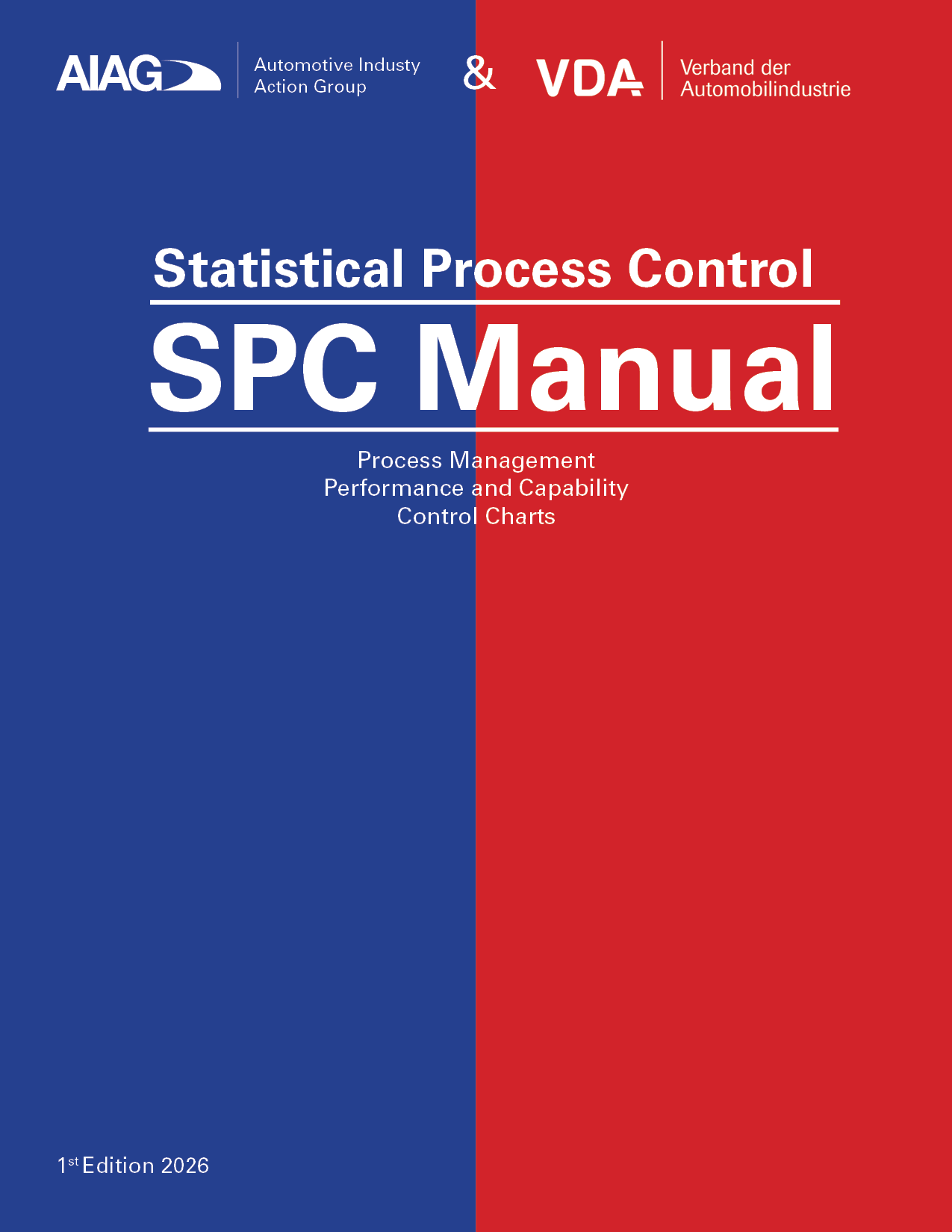
The new AIAG & VDA SPC manual aims to connect theory with real-world use, connecting the dots between statisticians, engineers, and technicians working on the shop floor.
AIAG and the German Association of the Automotive Industry (VDA) collaborated to develop the updated manual, which will be released on July 1, 2026. This update is a complete modernization of the SPC framework, not just a simple revision.
Here is a summary of the main improvements, how they affect your organization, and why many experts believe this update was needed.
For years, global automotive manufacturers have struggled with differences between the AIAG and VDA approaches to SPC. Companies working in North America and Europe have had to deal with different terms, methods, and expectations from OEMs.
SPC Volume 1 solves this problem.
The new manual offers a single SPC framework created by both organizations. For suppliers working with international OEMs, this means a consistent approach, one set of expectations, and a single reference for all customers. There is no longer a need for separate interpretations.
There’s long been confusion around capability indices in SPC, particularly about when to use Cp or Pp, and Cpk or Ppk. This uncertainty has resulted in inconsistent practices and frequent disagreements between suppliers and customers.
The new SPC 2026 manual provides clear, organized guidance on the differences between:
Each category now includes clear criteria for application and appropriate indicators: Cp/Cpk, Pp/Ppk, or Pm/Pmk. This clarity improves capability reporting, audit preparation, and the setting of realistic improvement targets. For quality engineers, this specificity is a significant improvement.
Traditional Shewhart charts (X-bar and R, individuals and moving range) remain essential to SPC practice. However, the new manual recognizes that a single chart type does not suit every process equally well.
AIAG & VDA SPC Manual expands the toolkit to include memory-based control charts such as CUSUM (Cumulative Sum), EWMA (Exponentially Weighted Moving Average), control charts for non-normal distributions, and tolerance-based control charts. It also provides selection criteria to help users choose the appropriate chart based on process behavior and data type, shifting from “use a control chart” to “apply the right SPC control chart.” In high-precision manufacturing environments, where detecting small process shifts early is the difference between acceptable output and a warranty claim, having the right detection method matters. For quality teams supporting complex or tightly tolerant processes, this expansion will directly improve your ability to act before defects reach the customer.
Many practitioners work with processes that naturally produce skewed data, such as coating thickness, torque, or chemical concentrations. In the past, these were forced into a normal distribution model, which often led to unclear or misleading results.
The new AIAG & VDA SPC manual addresses this by providing practical guidance on:
When the wrong distribution assumptions are made, it can mean missing real risks—or flagging good processes as problematic. That’s why this change is so important: it directly improves process improvement efforts, customer reporting, and audit success.
To dig deeper into this topic, we recently teamed up with AIAG for a webinar focused on Time-Dependent Distribution models. If you’re interested in how these updates can improve your SPC approach, be sure to check out the recording below.
One major improvement in the new AIAG & VDA SPC Manual is that it now clearly connects SPC with the other AIAG Core Tools. In the past, SPC often worked separately from FMEA, Control Plan, and MSA, which meant the data did not always support process decisions or reflect real process behavior.
The new manual ties SPC directly to each of the related Core Tools:
This version of SPC elevates it from a routine activity to an integrated component of your organization’s risk management and process stability.
The new manual is the first to address the advancements in automated data collection, real-time monitoring, and integrated quality software. The new manual includes guidance on:
For teams running SPC in a digital setting, these updates provide a trusted industry framework. If your organization is thinking about switching to a more digitalized SPC, you now have a clear, standards-based path forward.
At Plexus International, we have collaborated with AIAG and the automotive quality community throughout the development of this update. Our training programs are designed to translate the manual’s guidance into practical, shop-floor implementation.
The manual is now available for pre-sale. If you order now, you can lock in the current price until June 31st.
Want to train your team on the new SPC guidance? Check out our SPC training options or contact us to talk about private on-site or virtual workshops.
If you are interested in training your team on the new SPC guidance, please view our SPC training options or contact us to discuss private on-site or virtual workshops.
Subscribe to our newsletter.