“Your biggest quality risk isn’t internal, it’s 2 tiers down.”
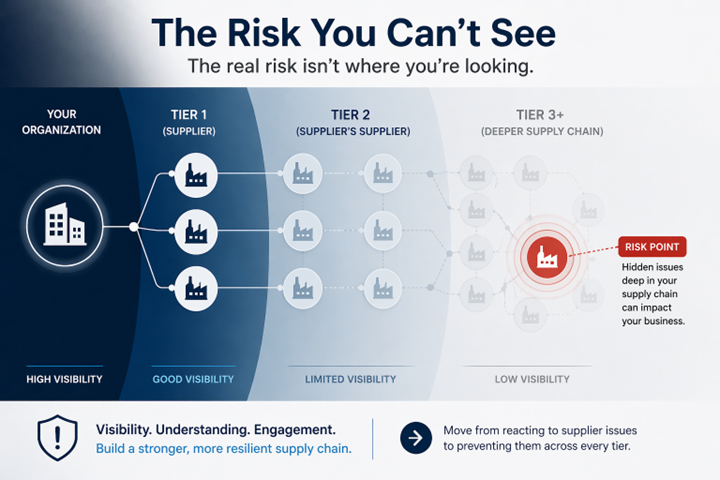
If you’ve spent any time in aerospace, you’ve likely seen this happen. On paper, everything looks fine. Your supplier is approved, certified, and hitting the metrics. Then suddenly something goes wrong—a late delivery, a quality escape, some kind of disruption—and your team is scrambling to respond.
At first, it looks like the issue is right in front of you. But when you dig into it, that’s usually not where it started. More often than not, the root cause is buried deeper in the supply chain.
That’s the part that’s easy to miss. Most organizations put a lot of effort into managing Tier 1 suppliers, and for good reason. There are audits, scorecards, corrective actions—there’s structure, and it generally works. But once you get past that first layer, visibility starts to drop off.
It’s not because people don’t care—it’s just how the system works. You rely on your suppliers to manage their own suppliers. You assume special processes are under control. You trust that capacity and capability are where they need to be.
Sometimes that trust holds up. Sometimes it doesn’t.
And when it doesn’t, the problem doesn’t stay buried in Tier 2 or Tier 3. It works its way up. Slowly at first, then all at once, until it lands on your desk.
What makes this tricky is that the warning signs aren’t obvious. You don’t get a heads-up that a sub-tier supplier is overloaded or that a process is starting to drift. Instead, you see the symptoms: a defect that slipped through, a delay that doesn’t quite add up, or a corrective action that looks closed but doesn’t actually fix anything.
So your team does what good teams do—they react, investigate, and fix the immediate issue. But then something similar happens again later. Maybe it looks a little different, but it’s really the same problem showing up again.
That’s not bad luck—it’s a signal. It usually means the underlying issue was never really addressed.
The shift here isn’t about finding a “bad supplier.” It’s about recognizing that your supply chain is a system, not just a list of vendors. Your Tier 1 suppliers are only one part of it. Underneath them is a whole network of sub-tier suppliers, each with their own risks, constraints, and maturity levels.
Somewhere in that network are pressure points—special processes, single-source dependencies, capacity bottlenecks. Those are the areas that can quietly become single points of failure. And when they do, the impact doesn’t stay contained—it moves upstream.
Companies that handle this well don’t try to control everything. They know that’s not realistic. Instead, they focus on understanding where they’re actually exposed.
They know which processes would shut them down if they failed. They understand where they’re relying on a single source, even if that dependency isn’t obvious. They keep an eye on capacity before it turns into a problem.
That kind of clarity doesn’t make things more complicated—it actually helps cut through the noise.
They also stop treating every supplier the same. Risk isn’t evenly distributed, but a lot of systems treat it that way. Some suppliers need more attention. Some need support. Others just need monitoring. Without that distinction, teams end up spreading themselves too thin and missing the real risks.
Another big shift is how they engage. You can’t just flow down requirements or increase audit frequency and expect Tier 2 and Tier 3 issues to improve. What actually helps is getting more involved—working through your Tier 1 suppliers to understand what’s happening below them, stepping in when the risk is high, and asking better questions.
It’s not always comfortable, and it doesn’t always fit neatly into existing processes. But that’s usually where the real issues come to light.
At the same time, stronger organizations don’t wait for failures to show up. They look for earlier signals—capacity trends, process stability, how work is actually being done. Audits aren’t just about checking boxes; they’re about understanding whether things are really working.
They’re not eliminating risk entirely, but they are seeing it sooner—and that makes a big difference.
The truth is, every organization is already dealing with Tier 2 and Tier 3 risk. It’s part of the system. The real question is whether you’re managing it proactively or just reacting when something breaks.
For a lot of teams, it shows up as constant firefighting—issues that feel random but keep coming back in different forms.
Once you understand where those issues are actually coming from, you can start to approach them differently. You can focus your effort where it matters, build visibility where it counts, and move away from reacting all the time.
And when that happens, supplier quality starts to feel a lot less like a constant struggle—and a lot more like something you can rely on.
If you’re ready to move from reacting to supplier issues to actually preventing them, explore how our consulting and coaching services can help you build real visibility across your supply chain.
Subscribe to our newsletter.